
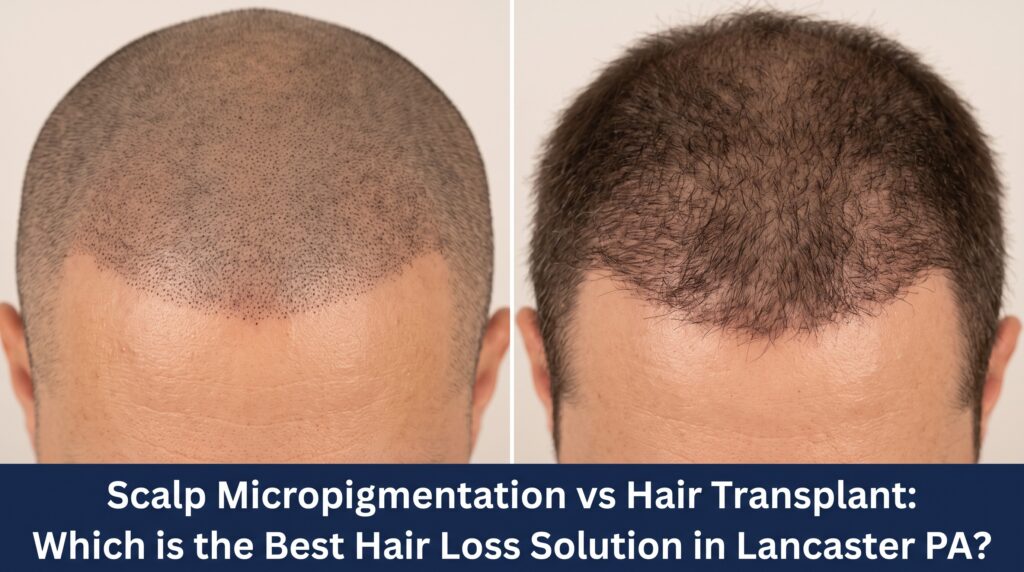
The Scalp Micropigmentation vs Hair Transplant decision is the fork in the road for almost every man confronting serious hair loss. Both promise restoration. Both cost real money. Only one involves surgery, anesthesia, donor site harvesting, and a recovery period measured in months. This guide compares the two honestly, including the situations where a transplant genuinely makes more sense.
Two Fundamentally Different Approaches
A hair transplant relocates living follicles. Surgeons extract grafts from a donor region, usually the back of the scalp, and implant them into thinning or bald areas. The transplanted hair grows because it is real hair with a real blood supply.
Scalp micropigmentation creates the appearance of follicles. Biological pigment is deposited into the epidermal layer using three round micro needles, replicating the look of closely cropped hair. Nothing grows. Nothing is harvested. Nothing is cut.
That distinction sits at the heart of the SMP vs transplant conversation. One is surgery. One is cosmetic pigmentation.
Why Men Search for a Hair Transplant Alternative
The demand for a Hair transplant alternative is not driven by squeamishness alone. It is driven by three practical realities.
Donor supply is finite
If you have advanced loss, you may simply not have enough donor follicles to cover the area. Surgeons will tell you this, though sometimes only after the consultation deposit.
Transplants do not stop progression
The native hair around your grafts continues to thin. Many men require additional surgeries as loss advances.
Recovery is real
Swelling, scabbing, shock loss, and a healing donor strip or extraction sites all take time. Final results appear twelve to eighteen months after the procedure.
A Non-surgical hair loss approach eliminates all three concerns. There is no donor requirement, no future surgery timeline, and no downtime beyond one or two days of mild redness.
[BOOK A FREE SMP CONSULTATION]
The Core SMP Benefits
- The SMP benefits worth weighing seriously include the following.
- Results appear the same day. Clients often see meaningful improvement after the first session.
- No downtime. Most people return to work immediately. Hats can be worn if preferred.
- No medication required afterward. Nothing to take daily, nothing to renew.
- Suitable for all loss patterns. Thinning, receding hairlines, bald spots, complete baldness, and scar camouflage all respond well.
- Predictable outcome. What you see after the final session is what you keep, subject to gradual lightening over years.
- Complete treatment in weeks rather than a year and a half.
The Cost Comparison
Hair transplant cost in the United States generally falls between $8,000 and $18,000 depending on graft count, surgeon reputation, and geography. Additional procedures as loss progresses add to that total.
SMP sessions at our Lancaster studio run $400 to $700 each, with three sessions typically required. Most clients complete treatment between $1,200 and $2,100.
That is a substantial gap. It does not automatically make SMP the Best hair solution for everyone, but it does mean the financial argument for surgery must be justified by an outcome that pigmentation cannot deliver.
When a Transplant Is the Right Call
Honesty matters more than sales here.
If you want to grow, style, and run your fingers through actual hair of meaningful length, a transplant delivers something SMP cannot. Pigment replicates a shaved or very short look. It cannot produce hair you can comb.
If your loss is limited, your donor area is dense, and you accept the recovery period and the possibility of future procedures, surgery is a legitimate path.
If you have a strong preference for biological rather than cosmetic solutions, that preference is valid.
Among all Baldness treatment options, no single answer serves every man. The right choice depends on your loss pattern, your budget, your tolerance for surgery, and the look you actually want.
[GET YOUR PERSONALIZED HAIRLINE MOCKUP]
Male Pattern Baldness and Long Term Planning
Male pattern baldness is progressive. It does not pause because you had a procedure.
This is the point most men underestimate. A transplant performed at thirty may look excellent at thirty two and awkward at forty two, as the surrounding native hair recedes around an island of grafted follicles. Surgeons manage this by planning conservative hairlines and reserving donor supply, but the underlying condition continues.
SMP adapts more gracefully. As loss progresses, additional pigment can be blended into newly thinning areas without surgery, without donor limits, and without a healing period.
Neither approach is a permanent hair solution in the absolute sense. Transplanted hair is permanent but the surrounding hair is not. SMP pigment lasts years before requiring a brief touch up. Anyone using the word permanent without qualification is overselling.
Reviewing real client transformations is the fastest way to understand what SMP actually looks like on a living scalp rather than in a rendering.
Comparing Hair Restoration Options Side by Side
- When men list their Hair restoration options, the field usually narrows to four.
- Medication slows loss but does not restore what is gone, and requires lifelong use.
- Hair systems create instant density but demand ongoing maintenance, monthly service, and constant vigilance.
- Transplant surgery restores growing hair at high cost with a long timeline and finite donor supply.
- Scalp micropigmentation restores the appearance of density immediately, at moderate cost, with no surgery and no maintenance beyond a periodic touch up.
SMP vs FUE Specifically
The SMP vs FUE comparison deserves separate treatment because follicular unit extraction is now the dominant surgical technique.
FUE harvests individual follicular units rather than a strip, which avoids the linear donor scar associated with older methods. It leaves small dot scars across the donor region instead. These are usually invisible under longer hair but visible on a shaved head.
Here is the detail many men discover late. A significant number of FUE patients later seek SMP specifically to camouflage donor dot scarring so they can shave their heads again. The two procedures are not always rivals. SMP frequently completes what surgery started.
Choosing a Provider in Central Pennsylvania
If you are evaluating Hair transplant Lancaster PA clinics against pigmentation studios, understand that you are comparing a surgical specialty against a cosmetic craft. Judge each by the work, not the brochure.
Our SMP clinic Lancaster PA studio sits at 911 State St. Vic Cortes has practiced SMP for over twelve years, trained alongside the pioneers of the industry at Gerow Hair Ink in New York City, and has served more than one thousand clients. He experienced hair loss himself, which shapes how consultations are conducted.
Clients researching Hair restoration Harrisburg PA providers regularly travel to Lancaster, as do men comparing Hair loss clinic York PA studios. We also see clients from across the region searching for SMP near Philadelphia PA, since experienced practitioners with a decade or more of specific SMP work remain uncommon.
Our studio reviews reflect a 5.0 rating across more than one hundred verified Google reviews.
Making the Decision
Book a free consultation with an SMP specialist. Book a consultation with a transplant surgeon. Compare what each tells you honestly, including what each says they cannot do.
A practitioner who never mentions a limitation is not being straight with you. We tell clients directly when their goals point toward surgery rather than pigment.
Our common questions section covers pigment behavior, session structure, and longevity in detail before you ever pick up the phone.
Consultations at our studio are free, private, and carry no obligation. You will receive a hairline mockup, a personalized quote, and an honest assessment of whether SMP suits your situation.
[CALL OR TEXT 717 333 7281]